


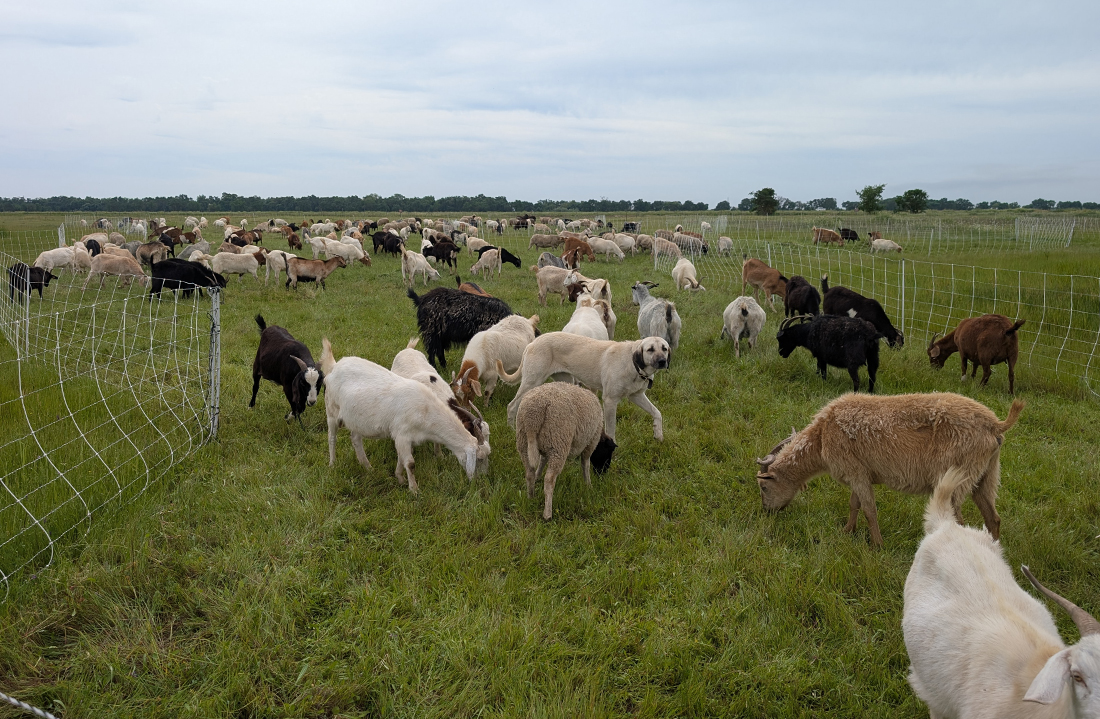
 Goats owned by West Coast Grazing munch invasive grasses at the Lincoln Receiver Site in California; fences keep them away from sensitive vernal pool areas. Livestock guardian dog Labrosa stands watch. Photo credit Maeve Henwood.
BY JODI PETERSON
One of the rarest habitat types in California is found on Beale Air Force Base in the Central Valley: vernal pools. These shallow seasonal ponds host an array of unique plants and animals, many of which are protected under the federal Endangered Species Act.

The Department of Defense, like every federal agency, must comply with the ESA and conserve protected species. At Beale, that includes fencing off the vernal pools so they’re not disturbed by military training and keeping them from being smothered by thick non-native grasses. Controlling those grasses is a challenge, though — mowing with machines can be damaging, applying pesticides can harm sensitive pool species, and setting prescribed fires is not feasible.
Enter the grazers. On the main installation at Beale, cattle munch down the grass. At the 235-acre Lincoln Receiver Site, though, it’s goats, since this annex property lacks strong fences to contain cows. The four-legged mowing machines at LRS are owned by West Coast Grazing and have been brought in through a partnership with CSU’s CEMML, which provides natural and cultural resource management services to federal partners such as the DoD.
The agreement with West Coast Grazing began in 2025 and is slated to last 5 years, depending on funding availability. The company supplies 250 goats, temporary fencing, herding dogs, and a livestock guardian dog to fend off predators. The goats chew thick grass on the site down to manageable levels, breaking down thatch and allowing the vernal pools to thrive. “Grazing is a lot less harsh on the landscape than other methods,” said Ethan Snee, CEMML project manager. “It’s been shown to be the go-to method for maintaining vernal pools — and it’s just neat to see too.”
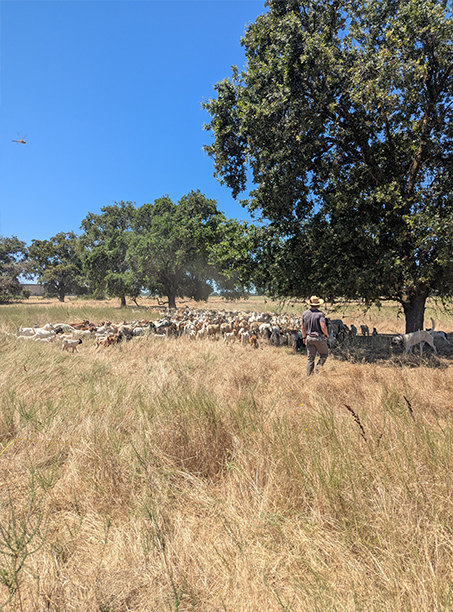
California’s vernal pools, filled by winter and spring rains, help to recharge groundwater and control flooding. When dry, the basins host brilliant swaths of wildflowers, many found nowhere else. When wet, tiny crustaceans swim in their shallow depths, including the vernal pool tadpole shrimp and vernal pool fairy shrimp, both protected under the federal ESA. Another vernal-pool-reliant species, the toad-like western spadefoot, has been proposed for both federal and state protection.
CEMML works with Beale’s natural resource management program to determine specific goals for the pools at the LRS. Snee provides oversight, and his team surveys the vegetation regularly to see how it changes over time. “Historically the Central Valley did not have these non-native grasses. If you don’t graze a site, these grasses take over and suck up more and more water, and there goes the habitat for the shrimp and spadefoot,” Snee explained.
The positive results of the goat grazing project are already apparent, said Andrew Bowler, owner of West Coast Grazing, which is based in Pescadero, California. “The goats are a fantastic tool. They mow down whatever’s there, including noxious plants, and their droppings improve soil health. This spring at LRS we saw more California poppy and other wildflowers.” Bowler, a CSU grad (B.S. in agricultural sciences, 2018), learned the goat business from other alums: Lani Malmberg (M.S. in weed science) and her son Donny Benz (B.S. in finance and real estate; MBA), who run a Colorado-based grazing company called Goat Green. “It’s very cool to be working with CEMML given that I’m a CSU grad and so are my mentors,” Bowler noted.
Historically, millions of vernal pools were thought to have existed throughout the Central Valley. But agriculture, housing, and other forms of development have caused them to dwindle. Now, less than 5% of these pools remain — which makes the Air Force’s conservation efforts at Beale especially important. The installation has worked with CEMML for more than a decade on many other projects as well, such as monitoring construction projects for compliance with environmental laws; surveying special-status birds, frogs, bats, and beetles; and restoring monarch butterfly habitat.